Payer contract renegotiation

Ask a payer for a better rate, with the numbers to back it.

For one payer, each code on your fee schedule next to what your other payers pay and what Medicare pays in your area, with your own volume. Set your asks, see what each is worth a year, and take the case to the payer as a PDF.

Get startedSee an example

On the Group plan, $499/month · cancel anytime

What you take to the payer

Each code, the comparison, and what your ask is worth.

RenegotiationPayer A · Main St clinicExample — made-up payers and made-up rates
2 asks

Contract renews 30 June. Last day to give notice: 1 April.

CodePayer AYour other payersMedicare% of MedicareClaims a yearYour askA year
99214$112.40$117.50–$131.20$108.00104%1,240$128.00+$19,344
99213$90.00$93.60–$100.80$92.0098%1,800$100.00+$18,000
99215$158.90$179.20$152.00105%300——

Talking points, 99214: Payer A publishes $112.40, 104% of Medicare in your area ($108.00). Your other payers publish $117.50–$131.20 for the same code; Payer B publishes $131.20, $18.80 more per claim. At 1,240 claims a year, $128.00 would add $19,344.00 a year.

Across 2 codes, the asks would add $37,344.00 a year at this volume. The asks are the practice’s own; every other figure is a payer’s published rate, Medicare’s, or the practice’s own upload.

Why it matters

“We’d like a raise” is easy to say no to.

A payer’s contracting team answers a general request for higher rates with a general no. What moves the conversation is specific: this code, this rate, against these figures, worth this much.

Most of those figures are already public. Commercial payers have to publish the rates they pay in-network practices, code by code, and Medicare publishes its rate for your area. What’s been missing is having them in one place, next to your own volume, when the renewal comes round.

MGMA reports that most medical groups have gone years without a commercial rate increase. A renewal is the chance to ask, and the notice period decides how long you have to prepare.

What a request needs

Four things a contracting team looks for, already in your account.

MGMA’s payer contracting checklist and most contracting guides ask for the same evidence. The packet assembles it from what RateBench already holds.

Specific codes and rates

The rate the payer publishes for your NPI, code by code, with the month of the file. Not your recollection of the contract: the payer’s own figure.

Your volume

Claims a year for each code, from the allowed-amount totals you upload, so each ask has a dollar value and the codes that carry the money come first.

Something to compare against

What your other payers publish for the same code, and Medicare’s rate for your area, with the payer as a percentage of it.

Time to make the case

The renewal date and notice period, with an email six months before renewal and two weeks before the last day to give notice.

The comparison

Three ways to read one row.

99214Your payers, one codeExample — made-up payers
Payer B$131.20
Payer C$117.50
Payer A$112.40
Medicare$108.00

Payer A pays $18.80 less per claim than Payer B for the same visit, and 104% of Medicare in this area.

Against your other payers. The same visit, the same clinician, paid differently by each payer. When one payer already pays you more for a code, asking another to match it is a request anchored in your own market, not a wish.

Against Medicare. Many commercial contracts are written as a percentage of Medicare, and it’s the common yardstick in a contracting conversation. The packet shows each payer’s rate as a percentage of Medicare’s rate for your locality.

What it’s worth. The difference per claim times your claims a year. For 99214 in the example: ($128.00 − $112.40) × 1,240 = $19,344 a year. Codes without an ask show no figure, so the total is only ever what you’ve chosen to ask for.
Talking points

Sentences you can use, written from your numbers.

For each code, the packet writes the points a contracting conversation needs, from the figures in the row and nothing else. No adjectives, no market claims, nothing you’d have to walk back.

  • Payer A publishes $112.40 for 99214, 104% of Medicare in your area ($108.00).
  • Your other payers publish $117.50–$131.20 for the same code.
  • Payer B publishes $131.20, $18.80 more per claim.
  • Unchanged since RateBench started tracking it in March 2026.
  • At 1,240 claims a year, $128.00 would add $19,344.00 a year.

Example, made-up payers and figures.

The PDF

A document to attach to your request.

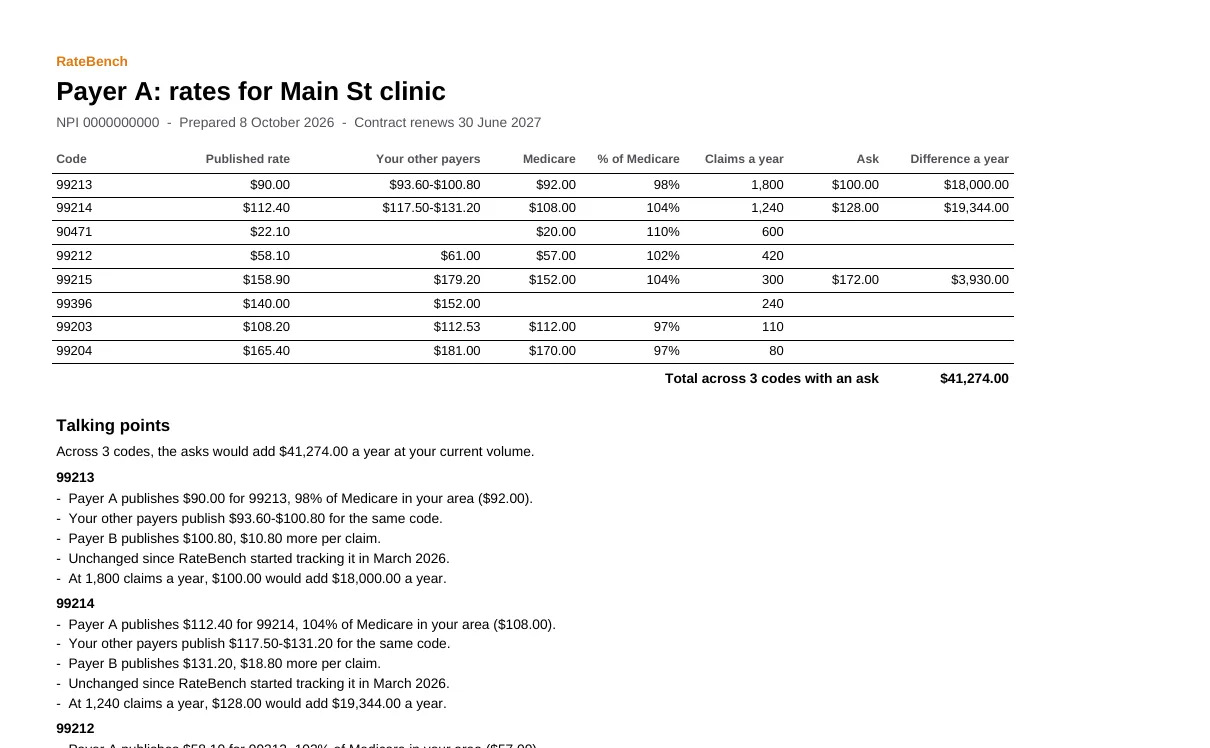
The table, the total, the talking points for each code you’re asking about, and where every figure comes from: the payer’s file and its month, the Medicare locality, and your upload. No patient data.

The first page of a sample renegotiation packet PDF: a table of codes with the payer's published rate, the practice's other payers, Medicare, percentage of Medicare, claims a year, the ask and the difference a year, then talking points.
A real packet, built by RateBench from made-up payers and figures.

Timing

Your renewal, with the reminders in it.

Enter the contract’s renewal date and notice period once. For a contract renewing on 30 June with 90 days’ notice, this is what happens:

  1. 30 DecReminder: renews in six monthsemailBuild the case: upload your allowed amounts, set your asks, download the PDF and send it with your request.
  2. Jan – MarThe conversationThe payer reviews the request and comes back. Your numbers stay current: every rate is re-read on the 1st of each month.
  3. 18 MarReminder: notice due in two weeksemailIf there is no agreement, decide whether to give notice before the window closes.
  4. 1 AprLast day to give noticeSet by the notice period in your contract: 90 days before renewal in this example.
  5. 30 JunContract renewsOn new rates if you agreed them. Monitoring shows the month they appear in the payer’s file.

How it works

From your fee schedule to a case, in one page.

  1. 01

    Pick the payer

    Choose a payer on one of your fee schedules. Its rates, your other payers’ rates for the same codes and Medicare’s rate for your area are already there. Fee schedule →

  2. 02

    Add your volume

    Your claims per code come from the allowed amounts you upload for the underpayment check. Totals only, no patient data. Say how many months the upload covers and it’s scaled to a year.

  3. 03

    Set your asks

    Type the rate you want for the codes that matter, with your best-paying other payer and Medicare beside each one. The page shows what each ask adds a year, and the total, as you type.

  4. 04

    Take it to the payer

    Download the PDF and send it with your request. Enter the renewal date and notice period, and the reminders follow.

In the conversation

Using the packet well.

Lead with the codes that carry the money. A few high-volume codes usually matter more than a long list. The packet puts the codes with the most claims first, and the value of each ask beside it.

Start with the payer’s own figure. The rate in the packet is the one the payer publishes for your NPI, dated. It’s hard to dispute a number from the payer’s own file.

Ask for a number. A rate per code, or one percentage of Medicare across the codes, gives the payer something to say yes to. “An increase” doesn’t.

Get it in writing, then check it. An agreed change should come as an amendment with an effective date. Monitoring shows the month the new rate appears in the payer’s file, and the underpayment check shows whether claims are being allowed at it.

Watch the notice period. If the payer won’t move, the notice deadline is when you decide what to do next. The reminder arrives two weeks before it.

Honest limits

Your numbers, not the market’s.

The packet compares a payer with your own other payers and with Medicare. It doesn’t show what other practices are paid: rate files list rates for providers who never bill a code, and a benchmark built from them can make a practice look better paid than it is. Where a payer publishes several rates for a code, the range is shown and the difference is worked from the highest, so the packet never overstates what you’d gain. It builds the case; you make it, and the payer decides.

Questions

Renegotiation, answered.

What goes into the renegotiation packet?

For one payer, each code on your fee schedule: the rate that payer publishes for your NPI, what your other payers publish for the same code, Medicare’s rate for your area and the payer as a percentage of it, your claims a year, the ask you set, and what that ask adds a year. Talking points are written from those numbers, and the whole thing downloads as a PDF.

Does it compare me with other practices or the market?

No. It compares the payer with your own other payers and with Medicare, which are figures you can stand behind. Market comparisons built from published rate files are full of rates for providers who never bill the code, and can make a practice look better paid than it is. We don’t sell a benchmark we can’t source.

Where does my volume come from?

From the allowed-amount totals you upload for the underpayment check: claims per code, no patient data. Tell it how many months the upload covers and it scales to a year. Without an upload, the packet still shows every rate and comparison, just no dollar figures.

Does it suggest what to ask for?

No, you set each ask yourself. Beside each code you can see your best-paying other payer and Medicare, which are the usual reference points, and the packet shows what each ask is worth a year at your volume.

Will it remind me before the deadline?

Yes. Enter the contract’s renewal date and notice period, and everyone on your team with alerts on gets an email six months before renewal and two weeks before the last day to give notice.

Which payers can I build a packet for?

Any commercial payer on your fee schedule. The comparison uses the other payers on that same fee schedule, so the more of your payers it holds, the more there is to compare against. Medicare doesn’t negotiate its rates, so it appears as the reference point, not as a payer to renegotiate.

Is the payer’s rate in the packet what my contract says?

It’s the rate the payer publishes for your NPI in its own Transparency in Coverage files, with the month of the file. That is the payer’s statement of what it pays you. If your contract exhibit says something different, that difference is worth raising too.

What does it cost?

The renegotiation packet is part of the Group plan, $499 a month, with up to three locations and unlimited specialties. On the Practice plan you can see a sample of it in the app. Cancel anytime.

Go into your renewal with the numbers.

The renegotiation packet is part of the Group plan, $499 a month, with your fee schedule, underpayment checks and rate monitoring across up to three locations. Cancel anytime.